Home- SV Seeker- Submarines- ROVs- Metal Working - About Us- Free Books - For the Troops- Store- Oracle DBA

In the Beginning
Origami Hull
  Paul's 65ft Origami
Steel vs Aluminum
Propulsion
  Junk Sails
  Background Info
  Diesel Engine
  Controllable Pitch
  Other Propellers
  Diesel/Hybrid/Elec
Pilot House
Canvas Work
Gantry and Hoist
Anchors
Winches
Block & Tackle
Rigging
Keels
Helm
Deck Crane
Sand Blasting
Painting
Electrical
Insulation
Refrigeration
Hatches / Portlights
Tender
Launch
Rules of Thumb
Links


Anchors

Anchor and Rode, aka Ground Tackle

Wire lasts far longer than fiber rope and has a smaller diameter than all but the spectra ropes. It is used all the time here with good success but one still needs chain for catenary (chain - catena - catenary) and for chafe resistance. It lays nicely on a winch and with a little guidance (a prying point and a bar in front of the winch), it will lay perfectly.
The smaller diameter comes into play when anchoring in current in deep water for some fishing operations. A wire roded boat will stay on a delicate hold in more current (because of the smaller diameter) than fiber ropes and weighs less than all chain. The touted stretch of nylon is insufficient to do anything positve - Nylon is used because it sinks, is strong, doesn't much degrade, and somebody said its stretch will keep your anchor from pulling. That being said, the stuff Easy uses is good for small boats but one still needs chain.  Spectra (UHMW, Dyneema is slightly better/more expensive) fibers have almost entirely replaced wire on winches here because of the tangle problems with wire Easy mentioned. I have anchored in deep water with an added shot of spectra and it worked very well. My personal preferred set-up now for a forty foot boat or so is; as much chain as one feels he can afford in weight (maybe 60' of 3/8" - I use only 25 feet of 5/16" because I anchor in rocks with very little scope but I have a bigger anchor/more,heavier chain onboard.), several hundred feet of nylon (consider it expendable and the only part that wears and needs replacement every few years unless you break an anchor), then the rest in spectra rated higher than the nylon - If it ever were to part (if I get a little fray near the bottom of the rode from a rock, I leave it - that way, when it parts it will be near the bottom and all I have lost is anchor and chain - remember I am in rock 90% of the time. The bugger is re-eyeing the double braid nylon after it ages.), the nylon would serve as your weak link, the nylon will be used a vast majority of the time, and when you fish in 600' or in a 2knot current in 200', you'll appreciate the spectra, which was kept nicely out of the sun by the covering of nylon on the winch.
I wouldn't use wire on a windlass and one wud need a large diameter head to accommodate it anyway. Spectra works well, flakes well, but requires more wraps to keep from slipping.

When fishing, I anchor two to seven or eight times a day but the techniques I use are contrary to secure anchoring (staying put overnight, e.g.) in typical conditions. Solid jagged basalt holds amazingly well. When in rocks (basalt or coal/shale, jagged), I minimize the scope, usually just 1 1/2 to 1 and the anchor will find a home almost instantly that will not pull out until pulled forward on. Danforths, Fortresses, etc. are one-time use in this circumstance, expensive anchors (CQR, Bruce) are a waste, though I used Bruces or a Davis SeaHook/Furfjord with a break-away until Lewmar started importing the cheap Chinese junk. The cool thing about these lousy anchors is, though I feel guilty using them and they are ugly, they will break if you really reef on 'em and you save your chain, the store gives you a replacement (until they catch on - try Redden Marine in B-ham), and they are cheap enough that anyone can afford spares. Their breaking propensity is reliable enough that a break-away tie-up is unnecessary and, in fact, undesirable as it makes your hold less stable - simply use a little heavier rode than otherwise (I use 3/4" Sampson Braid @ nom. 19,000lbs. and add 7/16 Amsteel Blue Dyneema @ 21,00lbs.) and pull forward and at an angle and the anchor shud break if badly hung (40', 18,000 pounds). Letting the chain and rode get wrapped up in rock will get more expensive. Much scope is bad here. Of course, anchoring anywhere else will entail conventional technique. These type anchors hold nowhere near as well as Danforths and such in sand, clay (the best holding if you can find it) or gravel.     -- mark775 boatdesign.net
 

Build Your Own Anchors


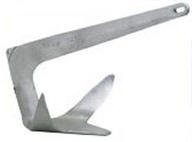
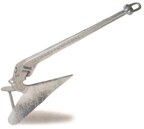
Claw Anchor, 176 lbs for $535.

46" Bauwagga Anchors

Bauwagga Anchor

Raya Spade Anchor

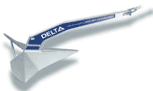
Delta Anchor with solid shank.
 

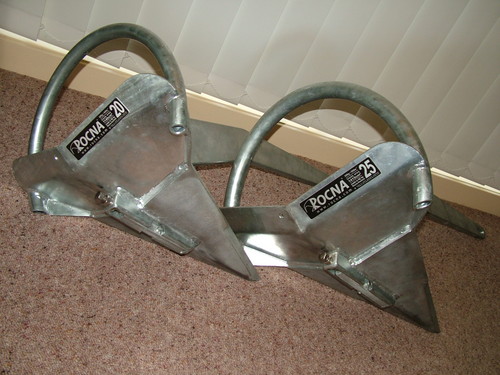
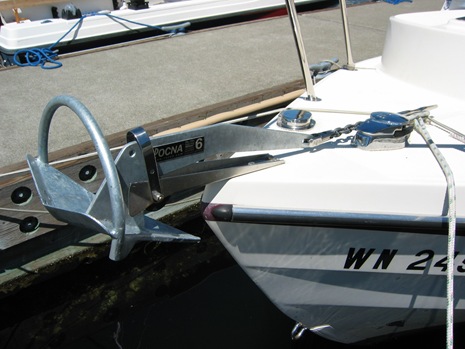
Rocna with a detachable shank.

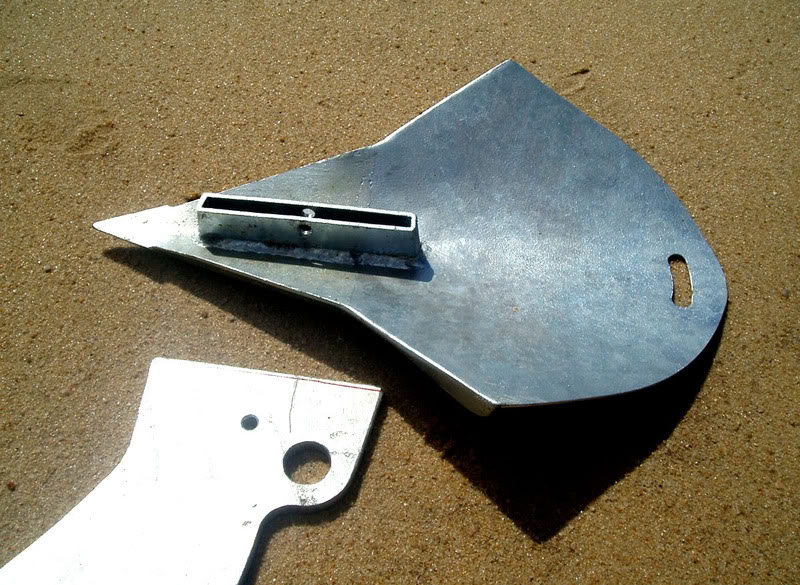
...and close up.

Ronca Anchor

Spade with a detachable shank.

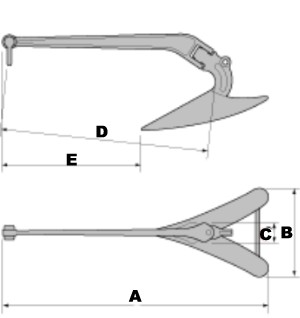
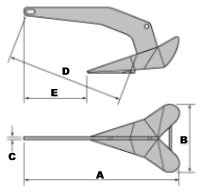
A: 1190    B: 412    C: 94
D: 978      E: 570

CQR Anchor

A: 1270   B: 567   C: 22
D: 963     E: 508 mm

Delta Anchor
 

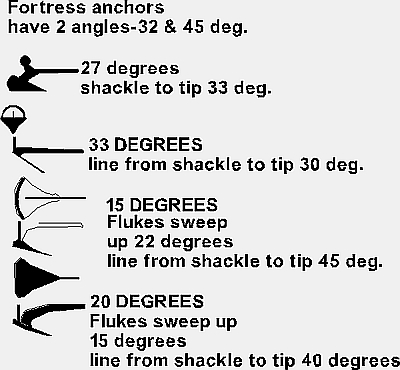
Fortress Design

Spade Design

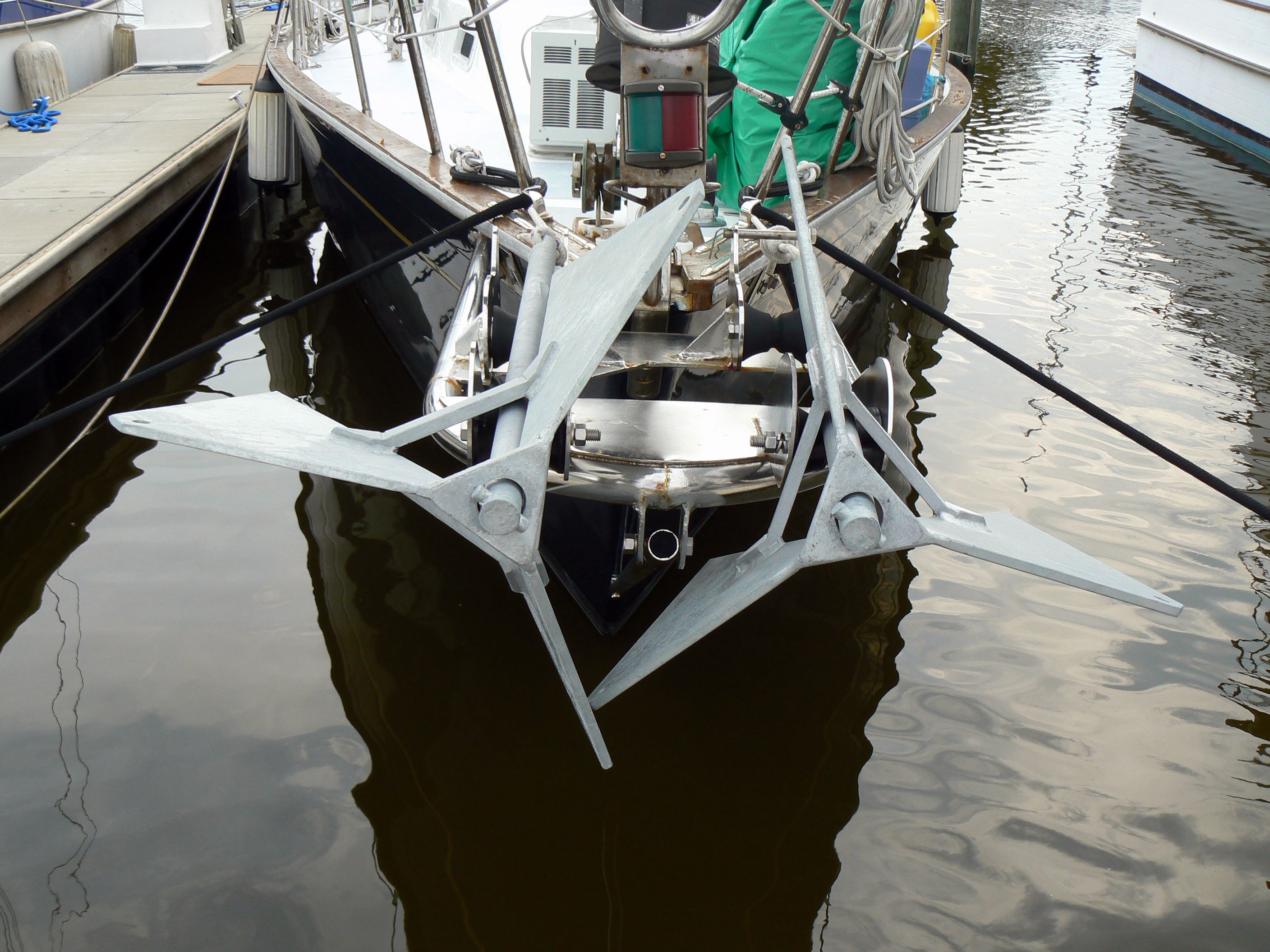
For SV Seeker we currently plan to carry home built anchors that we can build as needed.

Go2Marine has a 176 pound, galvanized, Claw anchor for $535 + shipping.  Around $660 with shipping.  That $660 buys enough scrap steel for 4 anchors, Add another $130 hot dip galvanizing and you've got a comparable anchor for less than $300.

Building your own anchors makes sense if you're already building a steel boat and especially if you're taking your tools with you. You're bound to loose one sooner or later and you may even be able to sell a few. 

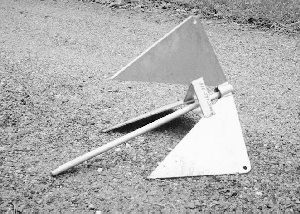
The Bulwagga anchor is a good design built from simple flat plates that can be stored in pieces and bolted together when needed.  If it's only going to be used for the occasional storm and mainly used as ballast below deck then have it galvanized is not even necessary.

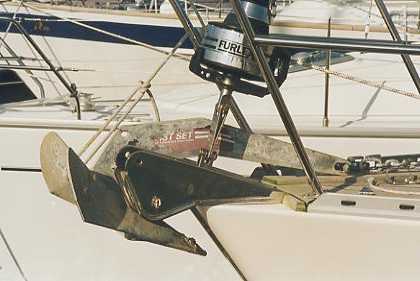
The delta, plow type anchor with a pivoting shank helps the anchor set and stay set even with moderate changes in the direction of pull. They as well can also be constructed from flat plate steel with some additional welding and they are a good candidate for everyday use on the bow. Having a shank that can be disconnected will also help a little bit when manhandling the thing is needed.

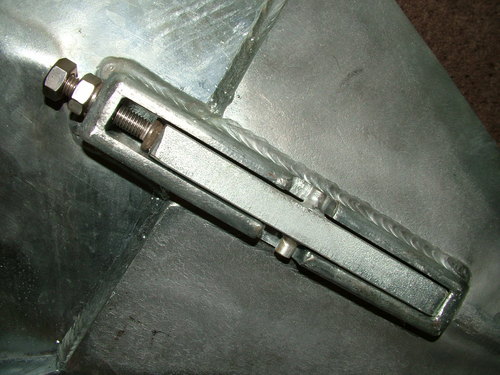
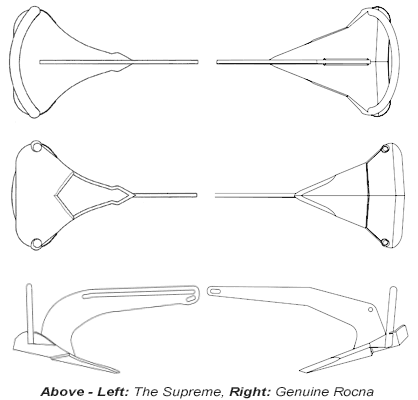
A spade anchor like the Raya or Rocna can also have it's shank made detachable for easier storage. And the roll bar of a Rocna could also be make detachable. 

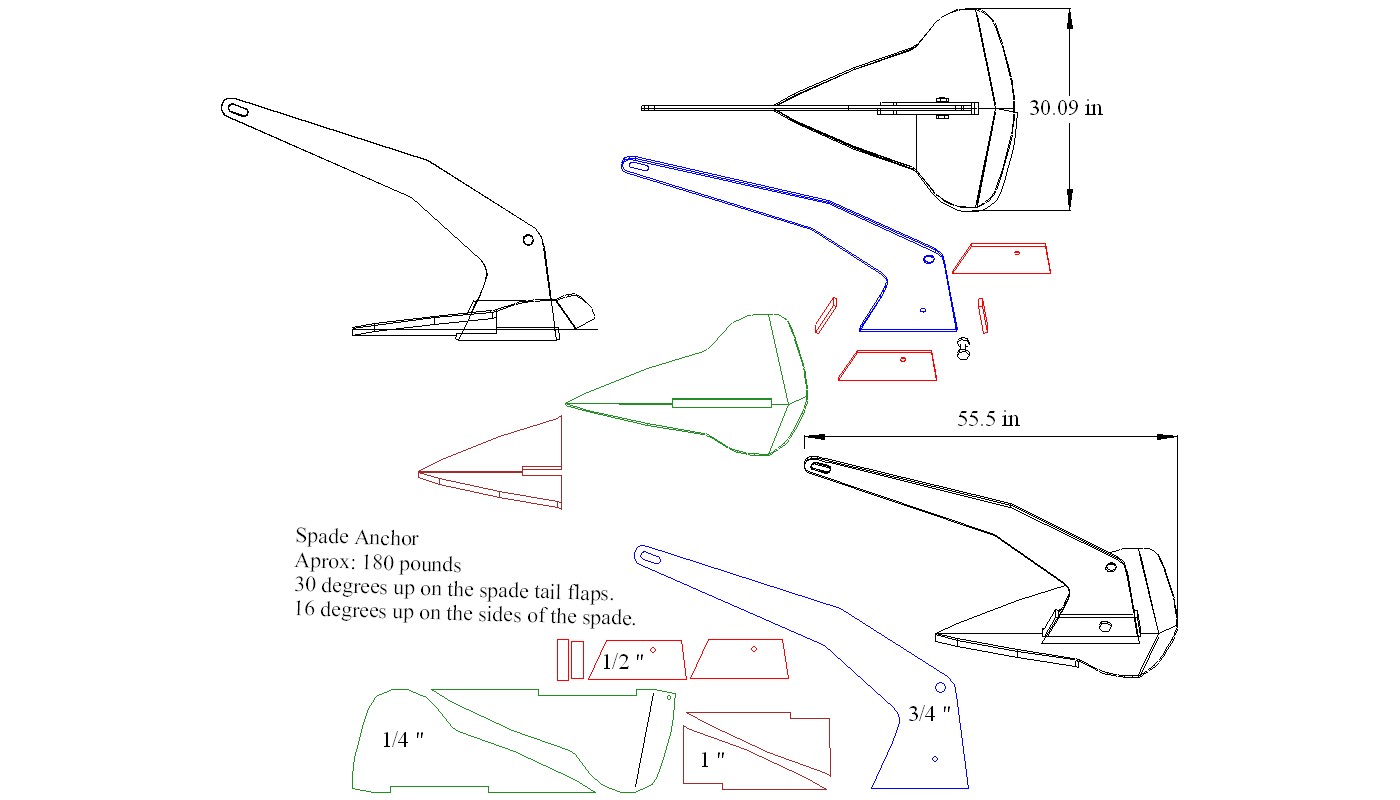
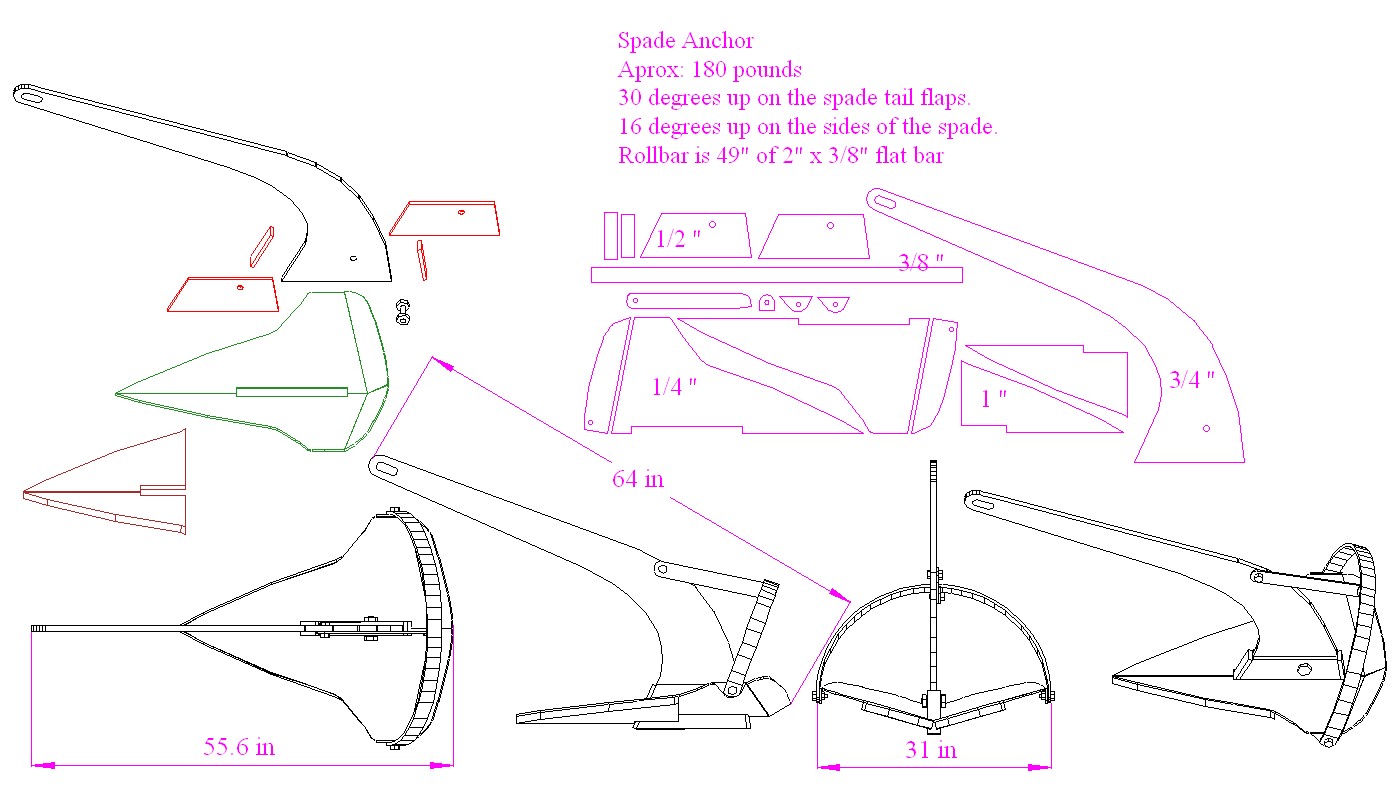
A little reverse engineering: A 154 pound Rocna has 417 square inches of surface.  I sized mine up to 540 sq inches. With 380 more sq inches in the shank for a total just under 930 sq in.  About 800 sq inches total for a Rocna 154 pound anchor. Steel weights .2833 pounds per cubic inch.  So 154 lbs / 800sq.in. / .2836 lb = .68 inch thick plate. So 3/4 inch plate puts us in the ballpark.  The forward half of the spade amounts for the majority of the weight.  So the spade could be 1/4 steel with a 1 in steel plate laminated onto the forward half of the spade.  The forward half would be about 200 sq in at 1.25 in thick and weight 200 * 1.25 * .2836 =  70 lbs.  The rear portion of the space would be 340 * .25 * .2836 = 24 lbs.  If we make the shank 3/4 in steel it would weight 380 sq.in * .75 in * .2836 lb = 80 lbs. Add another 10 pounds for the side plates, the box for the shank, and a piece of flat bar to make a roll bar, and the total weight comes to: 10 + 80 + 24 + 70 = 184 pounds ballpark.


A revision adds an optional and removable roll bar; makes the shank rounded to avoid snagging the rode and moves the trip line, or pendent line attachment point to the back edge of the spade. Not shown, but the 1 1/4",  blunt front edge would actually get a 45 degree taper with the torch after it's initially cut.

Rules of Thumb

Anchor Weight + Chain Weight (60 ft) + Rope Weight (200 ft) times 3 = Load on the winch.
Use shackles that are one size larger than the chain for attaching to the rope eye and anchor.
Strength of nylon drops by 15 to 20% when it is wet. Polyester is a little better
Nylon is repeatedly cycled at 50% of its breaking strength loosed 50% of its strength due to internal heat.
At anchor in the wind almost all boats tack back and forth on nylon rode with increased load. Change to chain and it's reduced.
Polyester stretches about half as much a nylon and is better at reducing chafe.