|
|
||||||||||||||||||||||||||||||||||||||||||||||||||||||||||||||||||||||||||||||||||||||||||||||||||||||||||||||||||||||||
Winches - Modify or Scratch BuildModifying a Winch Truck Winch
While pondering casting and cutting a lot of parts to build our own winch, we came across an old 1950's "White" truck winch in the 15 to 20 ton range for $600. We looked at a couple of others but this one was not frozen up, moved smoothly and had recently been in operation. But it was seriously ugly and beat up. An two great things about this winch was that it is it has a dog clutch that lets the spool free wheel. A brake on the spool so the spool and any load it has can be locked, and then the dog clutch can be disengaged and the winch motor can then power capstans added to the ends of the drive shaft. And finally it is a worm drive winch with a 29:1 reduction and worm drives by their design lock the load in place. So when the motor stops the spool will not move even when it is loaded. The down side is that the brake, capstans, and clutch control arm are all missing. And the brake collar that is the surface used by the band brake was badly bent from years a abuse. So the first order of business was to rebuild the brake surface. MIG Brazing
MIG Brazing is not a common process as most people have oxygen acetylene torches so they learn traditional brazing. But I got a crash course in MIG Brazing from a technician at our local AirGas welding supply store and it's a great way to go if you already have a MIG welder.
Silicon Bronze wire will cost you around $10 a pound. We use .035 and .045 with 100% Argon cover gas. Argon/He is recommended but 100% Argon works fine. It's a stiff smooth, wire so it has no problems feeding through the same umbilical and gun you use for steel wire. Getting the settings right on our Hobart Iroman 210 was a breeze. Just turn the heat down. Keep in mind that you are brazing, not welding. The wire is going to melt and spread across the surface and pile up. It's not going to dig into the base metal like welding. Getting our Lincoln Invertec power supply and Miller X-Treme suitcase welder to work took a lot of fiddling. For .045 Silicon Bronze wire the settings that worked were to switch the suitcase to "Soft Start" and 195 inches per minute feed and set the Lincoln to GMAW at 200 amps CC with positive to the wire. Preheating the parts is recommended but I and others have skipped the pre-heat with no short term problem,
Woodruff KeysThe drive shaft uses woodruff keys. But really big woodruff keys. That turn out to be a good thing because I discovered that I can cut large keys slots with a grinder and the keys are not difficult to make with a lathe and a few other tools. A mill would do a better job of cutting the slots but besides being cheap, we are also looking for acceptable methods for making repairs on a boat with the resources available to us, and we think it's better to learn and practice the skill now.
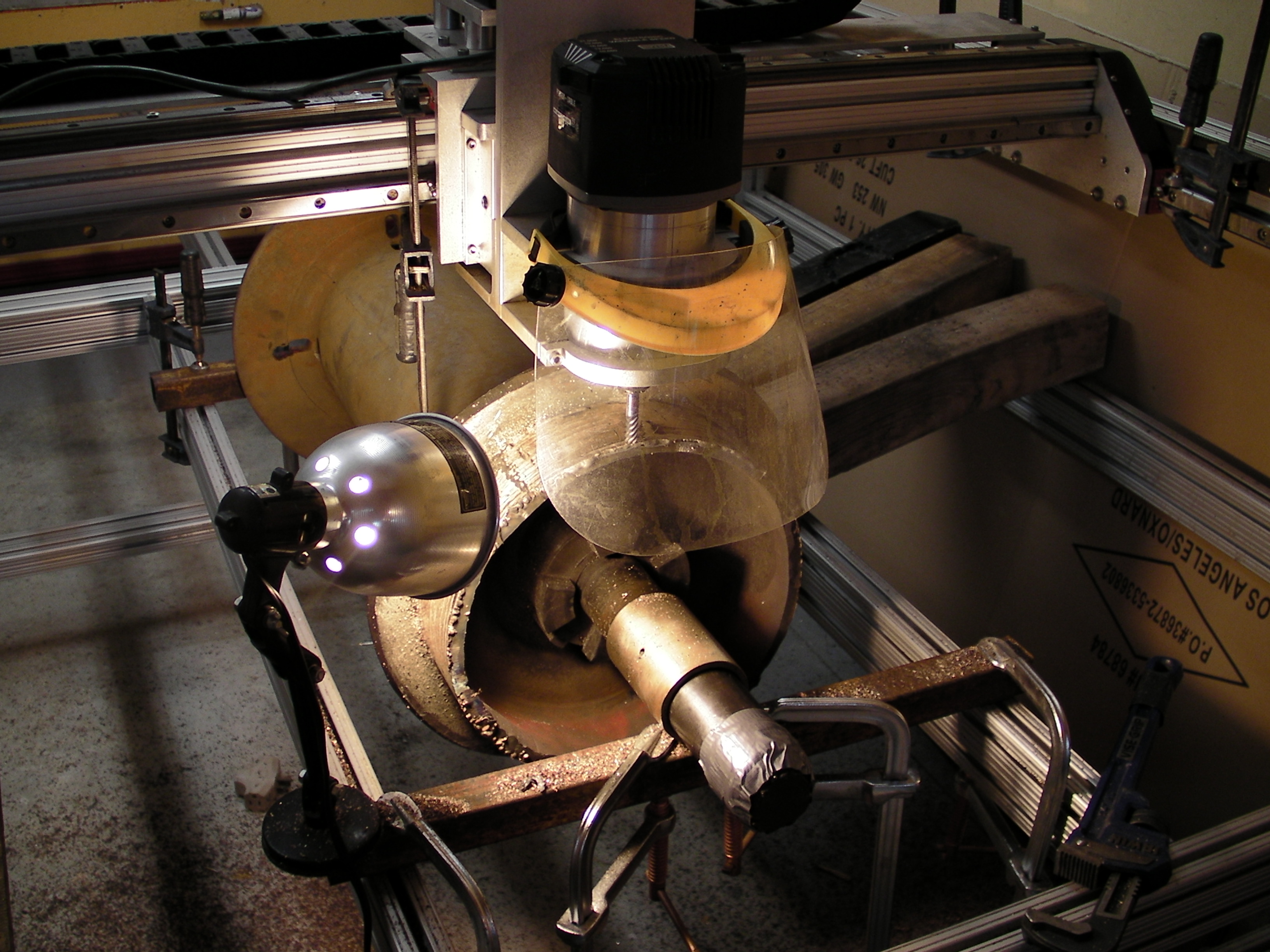
Tubing and Flat Bar Roller for Making a Brake BandOur winch did not have a brake so we are making one which required making a brake band so we picked up a tubing bender from Harbor Freight aka "Horrible Fright" and got it done.
Band BrakeAfter looking at pictures of winches, we copied the simplest design we found. This brake will be used much like a parking brake. So choose a brake lining that is a woven material designed for holding power more so that smooth braking. And Tulsa Brake and Clutch had a jig to drill the holes along with the rivets and rivet gun so we had them install the pad at the reasonable price of $75.
Rode Aka: Rope for the Anchor3/4 general purpose chain, Grade 30. Working Strength
10,600 lbs. Breaking Strength : 42400 lbs. 628 lbs/100ft
|
||||||||||||||||||||||||||||||||||||||||||||||||||||||||||||||||||||||||||||||||||||||||||||||||||||||||||||||||||||||||

















































|
Brent Swain has a design for a simple anchor winch in his book, and it's a perfectly good design for the most cursing boats but as RV Seeker is more work boat than cruising sailboat, I want a winch that has a few more capabilities, but I still don't want one of the fully electric or hydraulic commercial units you see on trawlers. Besides, we can't afford one of those anyway.
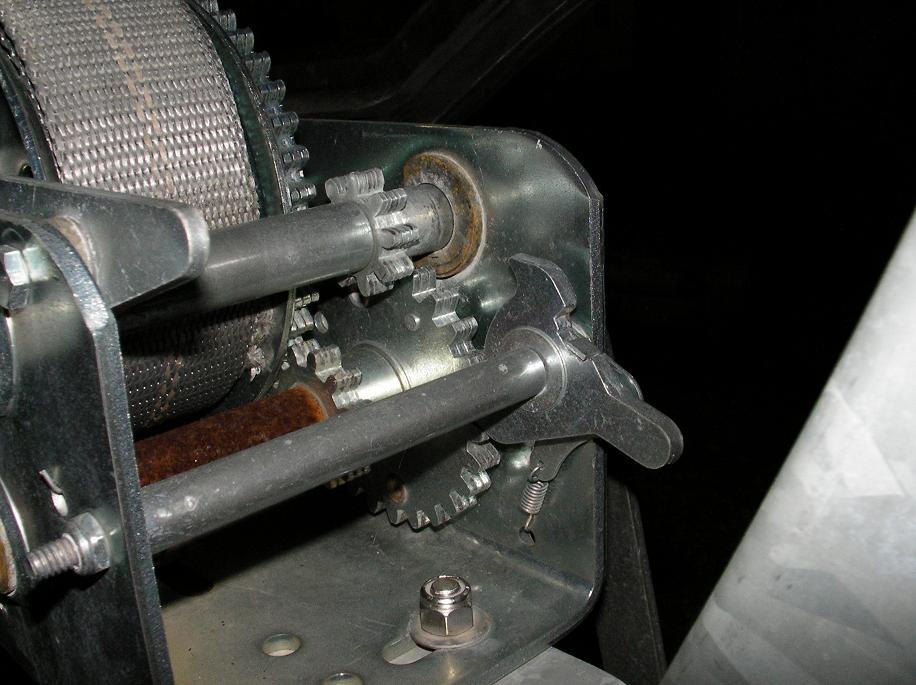
Out in my front yard was an example of a two speed manual trailer winch that will serve as a model for our anchor winch. The handles shaft can slide sideways when the latch on the left side is up. The small gear on the handle's shaft is either neutral, high speed or low speed. Spool gear: 42 teeth, Jack shaft gear; sm: 14, lg: 26. Crank: 9
|
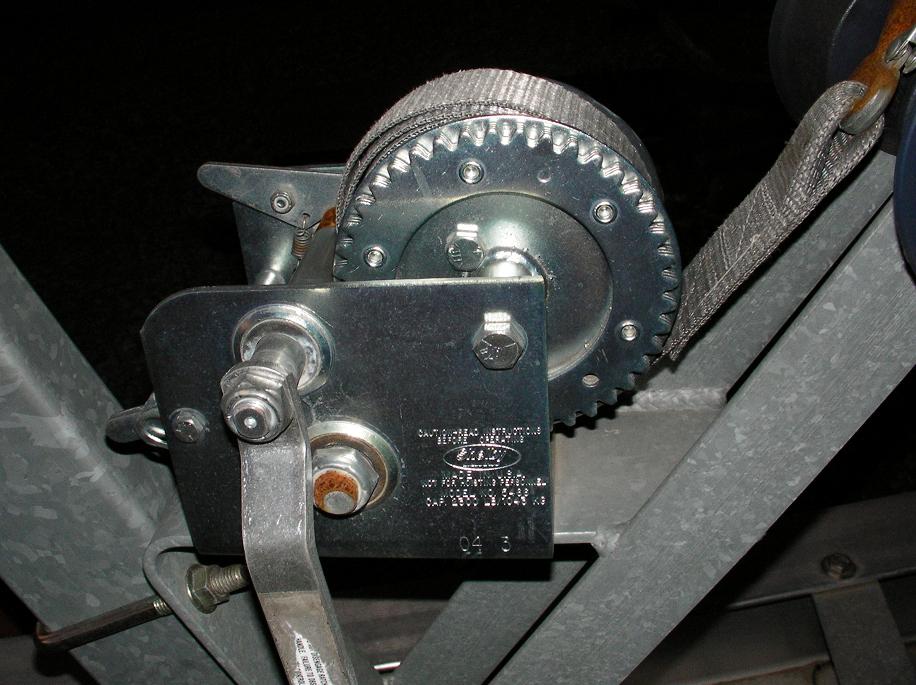


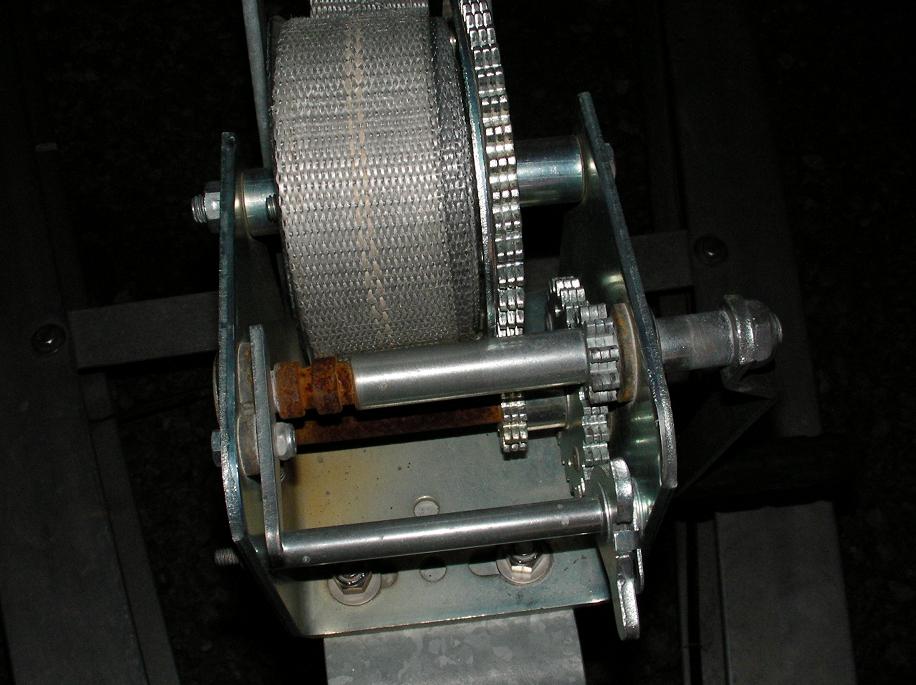
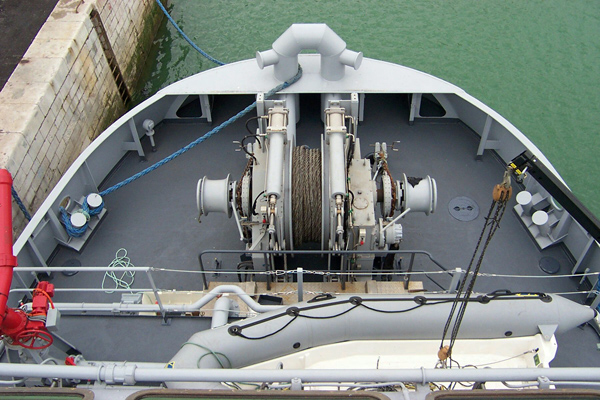
So the plan is to draw a plan based on the two speed manual winch that is on lots of boat trailers, and building something similar but much bigger with the addition of a crude brake and the possibility of powering it with an gear reduction or hydraulic motor. We'll have two of these units on the bow. The second will have smaller cable.
The boat winch reduction gear reduction calculates as follows: Spool gear: 42 teeth, jack shaft gear; small: 14, large: 26, and the crank has 9 teeth. So high speed is; 42/9 = 4.66 to 1. And low speed is 42/14 * 26/9 = 8.66 to 1.
|
|||||||||||||||||||||||||||||||||||||||||||||||||||||||||||||||||||||||||||||||||||
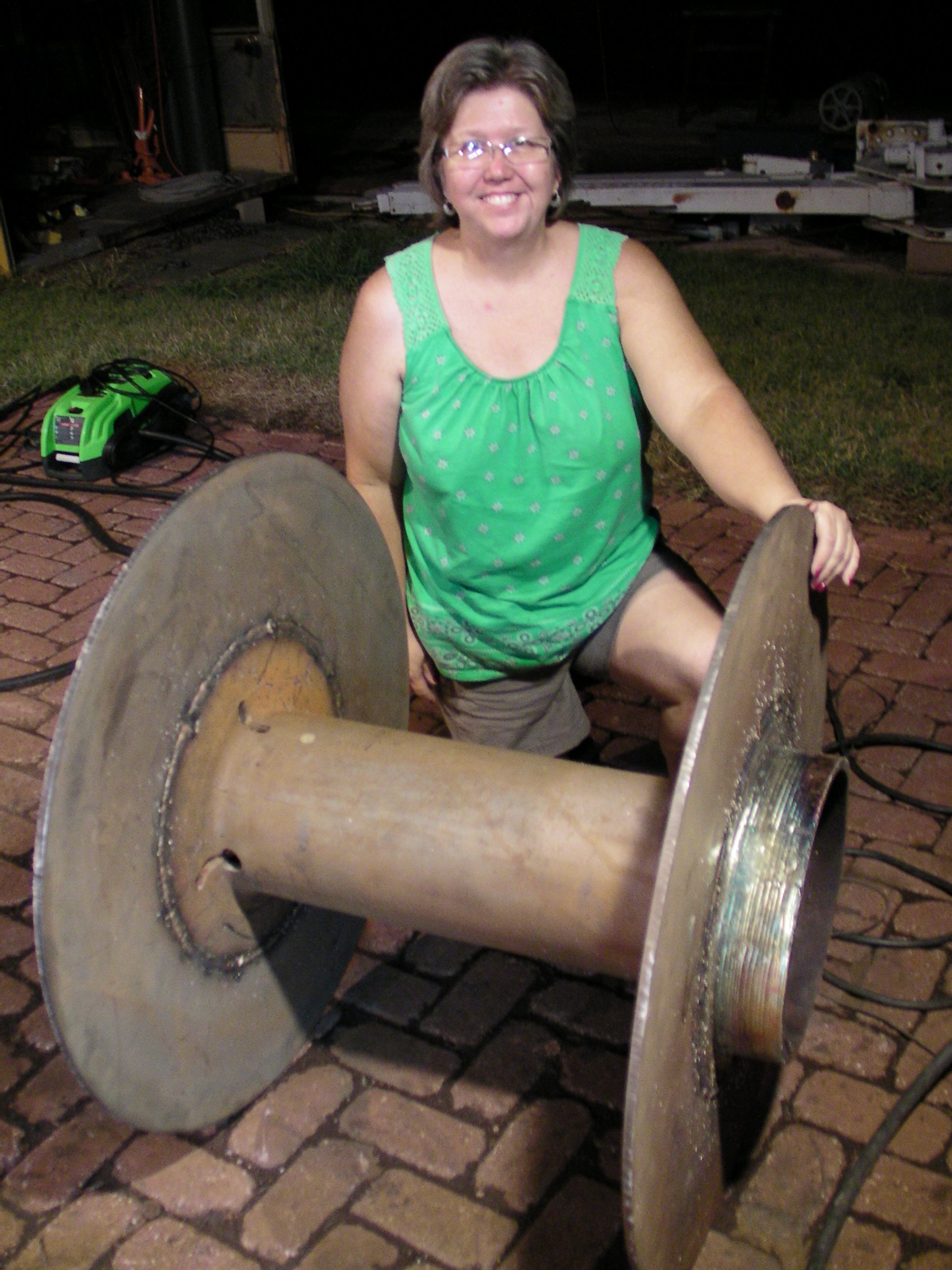
Step #2 Drum Design
A great tool is Ingersoll-Rand's:
Drum Capacity Estimator
We want to be able to
carry 500 feet of 3/4" steel cable on the anchor winch that will
give us over 25 tons of working load. Our drum turns out to be
tall and thin, mainly due to the distance between the bow and the
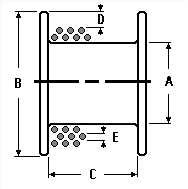
drum which is about 8 feet. The drum will be: (A) 12 x (B) 36
x (C) 5.5 inches and carry a working load of 500+ feet of 3/4" cable.
The details for the spool's capacity are listed in the chart, '3/4 "
Cable Capacity '.
|
Step #3 Spur Gear Design
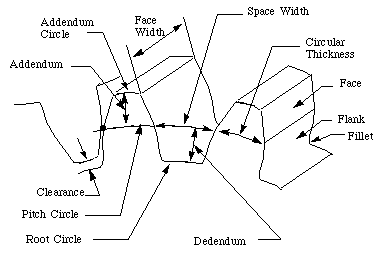
Forest Moon offers a free program for generating DFX files for specified Spur gears: www.forestmoon.com/Software/GearDXF Or you can use http://woodgears.ca/gear_cutting/template.html online application if you can convert from HPGL. If you'll need ring, rack or pin gears then for $26 you can get the full downloadable version of the Gear Template Generator program from http://woodgears.ca the outputs to DFX. I got the Gear Generator program from http://woodgears.ca because it will do inner ring grears, but the current version (2.05) calculates diametric pitch (DP) incorrectly, so if you need to covert DP to Pitch Diameter (PD) which is simply PD = Number of Teeth / DP. It also generates teeth with no Dedendum. So the best course of action is to generate all of your gears with the same program to help insure they work nicely together.
Need a quick lesson on gear ratios? See:
http://www.teamdavinci.com/understanding_gear_reduction.htm
Gear Formulas:
www.engineersedge.com/gear_formula.htm
PD = Number of Teeth / DP
DP = Number of Teeth / PD
|
||||||||

 40
ton holding, 7 ton pulling
40
ton holding, 7 ton pulling
Version #1
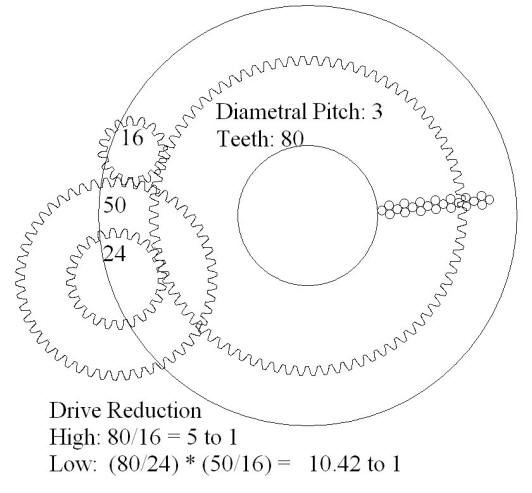
The first step is to simply scale up the boat winch design so that it fits on the the 36 inch tall drum for the cable. We also adjusted the reduction ratio to favor more power. Normally only 200 feet of cable will be used which is only the first 4 layers of cable on the spool, with about 50 feet and 7 (5.5/.75) wraps per layer. With a 5 to 1 drive with the high speed gears it will take about 7 wraps x 5 times gear reduction x 4 layers = 140 turns of the crank to real in 200 ft of anchor rode.
The maximum load on the boat winch is about 2000 pounds. The working load for 3/4" steel cable is about 12,000 pounds (Source). The boat winch handle is 7 inches long, 2000/7/12 = 23.8 foot pounds. With a 19" handle on the upscale winch it would be about: 12,000/19/12 = 52.6 foot pounds; doable but not easy. 35 pounds is considered the maximum recommended force to move a helm.
Version #2
Close to the same reduction ratios can be achieved with proportionally smaller gears which save weight, steel, and room. And another gear can be added that will allow a motor to dive the winch as well as the hand crank.
Another Example
I found a rebuilt Nabrico 40 ton winch for $2,800. These are mainly used a towing winches that raft together barges. It has a 7 ton pulling capacity with the 18.57:1 reduction.
Version #3
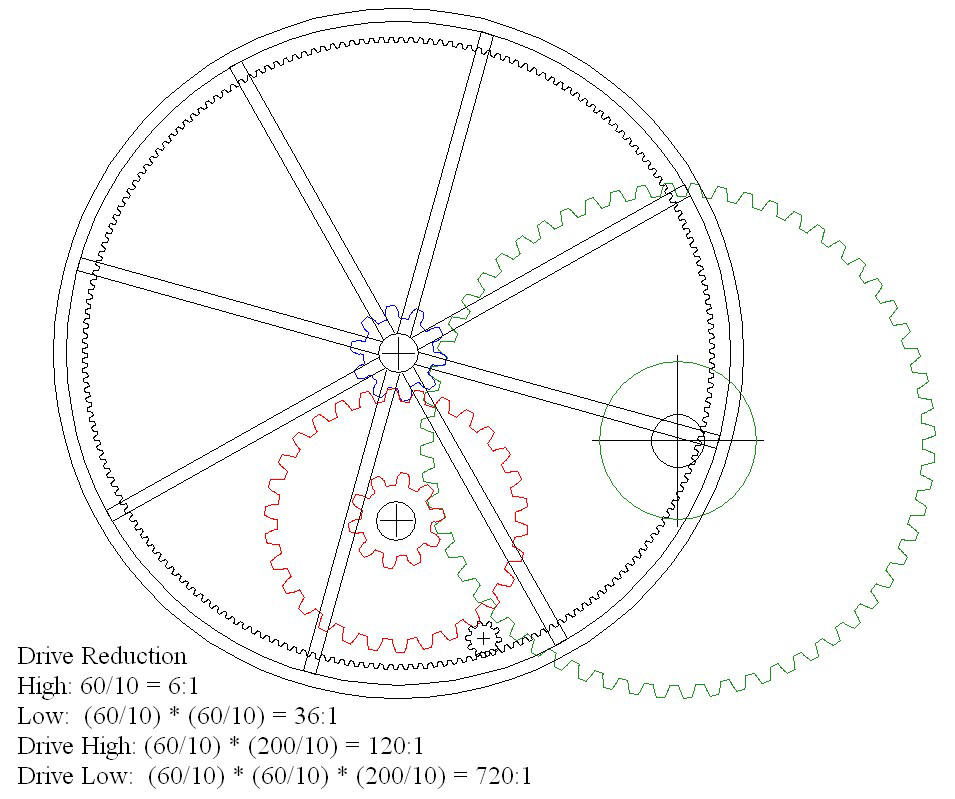
A hand wheel was added and the gear ratios changed to provide more power. The hand wheel is also an internal ring gear that can be optionally powered by a hydraulic motor. Turning by hand the high speed is 6:1 and the low speed is 36:1. So it will take 42 turns ( 6 x 7 warps) to pull in about 50 feet. In low speed, it will be able to pull with more that 7 tons for force.
Calculating a Bearing
Bearing performance is measured in pressure and velocity or "PV".
Solving for a working load of 10 tons on a 3" shaft with a 6"
bearing (3" on each side) turning at 60 rpm:
V in feet per minute = 0.262” x RPM x diameter
= 0.262” x 60 (rpm) x
3" (shaft)
= 47.16 fpm
P = total load / ( shaft diameter x bearing length )
= 20,000 lbls / ( 3” [shaft] x 6” [bearing length] )
= 20,000 lbs. / 18 sq in
= 1,111 psi
PV = pressure x velocity
= 1,111 psi x 47.16 fpm
= 52,394
You can also use Oilite's bearing calculator: http://www.oilite.com/bearingCalc.asp You can increase the area to reduce the PV if needed, but anything under 75,000 will not be hard to find if the P is under 4000 and V is under 500. See: www.buntingbearings.com/data.html for some ideas.
Add a Motor?
The path of that 19" handle makes a circle with a circumference
of about 119 inches ( C=dPi, 19 x 2 x 3.14). If we added a
great that size it would have 108 teeth on it and it could be driven
by a 16 tooth gear. A 2 hp DC motor from a treadmill is going
to spin at about 4500 rpm. The large crank gear will then move
at 666 rpm ( 4500 * 16 / 108 ). That's about 10 turns
per second! Way too fast. So we need more gears and the best answer
is likely a planetary gear set like is found on off road automotive
winches. Harbor Freight has a 5000 pound winch with a 294 to 1
planetary gear set and a 3.4 HP, 12 volt motor. With a
line speed of 5.3 ft. per minute off a drum that is about 6 inches
in diameter the RPM is about 33 ( 5.3 * 12 / 6 * 3.15 ).
If we added an 8.5 inch diameter, 24 tooth spur gear to the drum and
mesh that with the 80 tooth gear on the anchor winch drum, then the
anchor winch drum would spin at under 10 rpm ( 33 * 24 / 80 ).
Pulling in about 200 feet of rode in 3 minutes. ( 7 wraps * 4 layers
/ 10 rpm)
Sail Winches
Junk Rig sails are heavy but extremely easy to manage. A
block and tackle is used to raise and lower the sail which in our
case will weigh about 500 pounds. And then there are two sheet
lines. One for the port and one for the starboard. So
when the boat tacks or jibs the sail simply swings to the other side
of the boat slacking from the sheet that had the tension until the
weight is taken by the other sheet line. And the sheet lines
can also use a block and tackle to lessen the effort needed to haul
them in while under load.
www.surpluscenter.com/Brands/Dynamic/22-63-cu-in-DYNAMIC-BMER-1-375-WS-T4-WHEEL-MOTOR-9-8592-375.axd
Resources
Drum Capacity Estimator:
http://www.ingersollrandproducts.com/lifting/winches/drum.htm
Example:
http://motivationdocksupply.com/winches/hand-winches.php
Brands: Beebe, Tulsa, Braden, Garwood, Hyster, Thern, Nabrico